Criminal Mitigation Psychological Evaluation
When legal questions intersect with human psychology, attorneys and courts need clear, objective answers grounded in science. Forensic psychological evaluation services bridge this gap by applying clinical expertise to legal contexts—helping judges, juries, and legal teams understand the psychological factors that shape behavior and inform fair outcomes.
At Lighthouse Resolution Group, we provide evidence-based, court-focused evaluations for attorneys, courts, and agencies nationwide. Whether you need an in-person assessment or a secure remote evaluation, our forensic experts deliver thorough, defensible reports designed to assist courts in making informed decisions.
Understanding the distinction between clinical therapy and forensic evaluation is essential. While therapy focuses on treatment and healing, forensic psychological assessment answers specific legal questions—such as what factors contributed to an offense, whether a defendant can stand trial, or what sentencing approach best serves justice and public safety. This difference shapes everything from how interviews are conducted to how findings are documented and presented in court proceedings.
The sections that follow explain the types of forensic evaluations we offer, what attorneys can expect from the process, and how to refer a case for evaluation.
What Is a Criminal Mitigation Evaluation?
A criminal mitigation evaluation is a specialized forensic psychological evaluation designed to identify and document psychological, developmental, and social factors that may reduce a defendant’s culpability or support a more proportionate sentence. Unlike evaluations focused on guilt or innocence, mitigation evaluations ask different questions: Why did this happen? and What sentence best serves justice given this individual’s circumstances?
These comprehensive psychological evaluations examine the defendant’s life history, mental health, cognitive functioning, trauma exposure, and environmental influences. The goal is not to excuse the criminal act but to provide the court with a complete picture of the person before it—one that goes beyond the offense itself.
Lighthouse Resolution Group conducts mitigation evaluations for adult and young adult defendants in both state and federal courts. Our forensic psychologists integrate clinical interviews, standardized psychological testing, and thorough review of collateral records to produce reports that can withstand cross-examination and meet Daubert or Frye standards.
Cases Commonly Involving Mitigation Evaluations
Mitigation evaluations are most often requested in cases where standard sentencing risks overly punitive outcomes. Common scenarios include:
Serious felonies where prosecutors seek maximum penalties
Homicide cases at both capital and non-capital levels
Sex offenses requiring nuanced understanding of risk and rehabilitation potential
Multi-defendant conspiracies where individual culpability varies
Repeat offenses where underlying psychological factors may explain patterns
Example: Consider a 22-year-old defendant charged with aggravated assault following a bar fight. A mitigation evaluation reveals a history of severe childhood abuse, untreated PTSD, and a traumatic brain injury from adolescence. While these factors don’t excuse the behavior, they help the court understand the defendant’s heightened reactivity and impaired impulse control—information that can inform whether incarceration, treatment, or a combination best serves justice.
When Is a Mitigation Evaluation Needed?
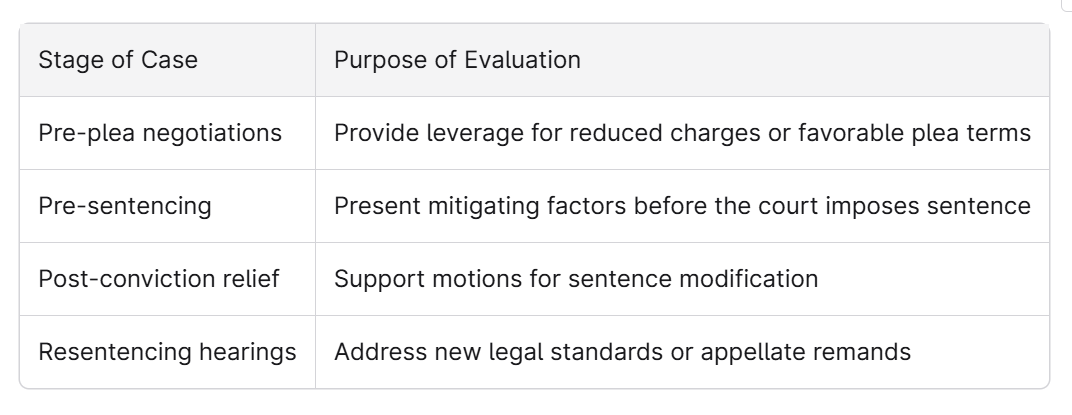
Timing matters in mitigation work. The earlier defense attorneys engage forensic services, the more thoroughly the evaluation can be conducted and integrated into the defense strategy.
Common Referral Points
Legal Contexts
Mitigation evaluations serve different functions depending on jurisdiction and case type:
Capital cases: Mitigation is constitutionally required, and evaluations are often extensive
Federal sentencing: Courts must consider 18 U.S.C. § 3553(a) factors, including defendant history and characteristics
State-level hearings: Post-plea or post-verdict sentencing where judges have discretion
Red Flags That Should Prompt a Referral
Defense attorneys should consider a mitigation evaluation when any of the following apply:
Long trauma history (childhood abuse, neglect, foster care involvement)
Suspected neurodevelopmental disorder (intellectual disability, fetal alcohol spectrum disorder, autism)
Severe substance use beginning in early adolescence
Unusual or impulsive offense behavior inconsistent with defendant’s baseline
Prior psychiatric hospitalizations or untreated mental illness
Defendant is under age 25 with limited criminal history
Key point: Mitigation can be highly relevant even when mental health issues do not meet the threshold for an insanity defense or competency concerns. Many defendants with significant psychological vulnerabilities are legally competent and criminally responsible—yet still deserving of individualized sentencing consideration.
Psychological Factors Considered in Sentencing
Sentencing courts increasingly expect evidence-based psychological information when weighing statutory and guideline factors. Judges want to understand risk, rehabilitation potential, and whether diminished culpability justifies departures from standard sentences.
Key Domains Addressed in Mitigation Evaluations
A thorough forensic psychological evaluation may address:
Personality structure: Patterns of relating, coping, and responding to stress
Impulse control: Capacity to pause, reflect, and choose behavior
Trauma effects: How past adversity shapes present functioning
Neurocognitive functioning: Memory, attention, executive function, and processing speed
Moral reasoning: Understanding of right and wrong, capacity for empathy
Risk of future violence: Evidence-based assessment of recidivism likelihood
Tools and Methods
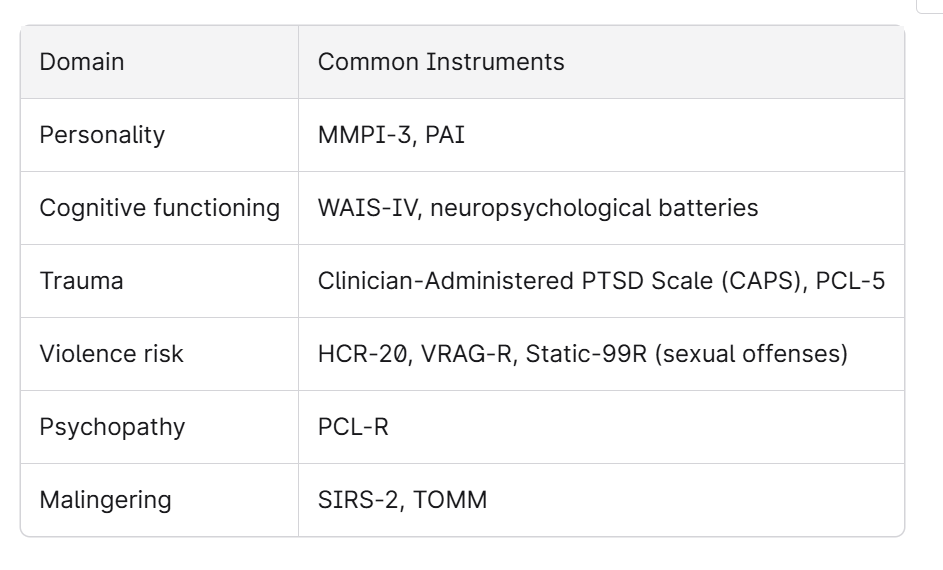
Forensic experts use a broad range of standardized instruments to support their opinions:
These instruments, combined with structured interviews and collateral records, produce findings that are both clinically meaningful and legally defensible.
At Lighthouse Resolution Group, we prioritize objectivity. Our reports provide balanced, well-documented opinions that can assist courts in making fair decisions—and that hold up under cross-examination and legal challenges.
Brain Development and Young Adult Offenders
Neuroscience has fundamentally changed how courts understand young adult offenders. The scientific consensus is clear: brain regions responsible for judgment, planning, and impulse control—particularly the prefrontal cortex—continue to mature into the mid-20s.
What This Means for Behavior
Young adults aged 18–25 often display:
Heightened reward sensitivity (seeking thrills without fully weighing consequences)
Reduced executive functioning (difficulty planning ahead or inhibiting impulses)
Increased susceptibility to peer influence
Greater vulnerability to stress and trauma effects
These neurobiological realities don’t eliminate criminal responsibility, but they do affect how courts should understand and respond to offenses committed during this developmental window.
Legal Recognition of Developmental Factors
U.S. courts have increasingly acknowledged developmental differences:
Roper v. Simmons (2005): Prohibited death penalty for juveniles
Graham v. Florida (2010): Banned life without parole for non-homicide juvenile offenders
Miller v. Alabama (2012): Prohibited mandatory life without parole for juveniles
While these rulings apply formally to those under 18, the underlying neuroscience extends to young adults. Defense attorneys increasingly use developmental mitigation arguments for defendants through age 25—and courts are listening.
Practical application: The Pathways to Desistance study, which tracked over 1,300 juvenile offenders longitudinally, found that 90% desisted from crime by age 25 without lifelong incarceration. This research supports arguments that rehabilitation, not lengthy imprisonment, serves both the individual and public safety for developmentally immature offenders.
Lighthouse Resolution Group routinely evaluates late adolescents and young adults, translating neuroscience and developmental psychology into clear sentencing themes for judges and juries.
Trauma, Mental Health, and Criminal Behavior
The relationship between early adversity, mental illness, and criminal behavior is well-documented. Understanding this connection is essential for fair sentencing—not as an excuse, but as context that informs proportional responses.
The Trauma-Crime Connection
Research consistently shows:
Individuals with 4 or more Adverse Childhood Experiences (ACEs) face 7–10 times higher risk of adult criminality
50–70% of incarcerated individuals meet criteria for PTSD
Foster care alumni show 3x higher recidivism rates without trauma-informed intervention
Untreated bipolar disorder doubles violence risk
Prolonged trauma exposure affects brain development, particularly the hippocampus (memory) and amygdala (threat response). This can result in hypervigilance, dissociation, impaired judgment, and difficulty regulating emotions—all of which may contribute to criminal behavior.
Mental Health Conditions Relevant to Mitigation
Forensic evaluations often identify conditions that shaped the defendant’s functioning at the time of the alleged offense:
PTSD and complex trauma: Dissociative episodes, exaggerated startle responses, emotional dysregulation
Depression and bipolar disorder: Impaired judgment, hopelessness, impulsivity during manic phases
Psychotic disorders: Paranoia, command hallucinations, disorganized thinking
Substance use disorders: Self-medication of underlying conditions, impaired decision-making
Neurodevelopmental disorders: Intellectual disability, ADHD, fetal alcohol spectrum disorders
How We Gather Trauma Histories
At Lighthouse Resolution Group, we use multiple methods to develop accurate trauma histories:
Clinical interviews with semi-structured formats
Validated trauma measures (CAPS, PCL-5, CTQ)
Review of medical, school, and child welfare records
Collateral interviews with family members and treatment providers
Our reports carefully distinguish between credible trauma-based explanations and unsupported self-report. We use validity scales and malingering measures to ensure findings are defensible and accurate.
Acknowledging trauma and mental illness does not excuse criminal behavior—but it can contextualize it and inform sentencing that addresses underlying causes while protecting public safety.
What Attorneys Can Expect From the Process
Lighthouse Resolution Group follows a structured evaluation process designed to minimize burden on legal teams while maximizing the quality and utility of findings.
Step 1: Initial Consultation and Case Screening
The process begins with a consultation to determine fit:
Review of charges and legal context
Identification of key legal questions the evaluation should address
Discussion of deadlines and court dates
Screening for conflicts of interest
Preliminary assessment of whether the evaluation question is answerable
Step 2: Records Review
Before meeting the defendant, we conduct a thorough review of available records:
Prior assessments and treatment records
Medical and psychiatric history
School records and educational testing
Criminal history and prior evaluations
Child welfare or social services records
Step 3: Clinical Interviews
Clinical interviews typically span 4–8 hours across 2–4 sessions. We use semi-structured formats like the Structured Clinical Interview for DSM-5 (SCID) to gather comprehensive developmental, family, trauma, and psychiatric history.
Step 4: Psychological Testing
When indicated, we administer standardized psychological assessment instruments:
Personality inventories (MMPI-3, PAI)
Cognitive and neuropsychological testing (WAIS-IV, specialized batteries)
Trauma measures
Risk assessment tools
Malingering and validity measures
Step 5: Collateral Interviews
We interview family members, prior treatment providers, and others who can provide context about the defendant’s history and functioning.
Step 6: Integration and Report
Findings are integrated into a detailed written report (typically 20–50 pages) that:
Answers the specific referral questions
Provides DSM diagnoses where appropriate
Explains how psychological factors relate to the offense
Offers sentencing recommendations grounded in evidence
Addresses risk and rehabilitation potential
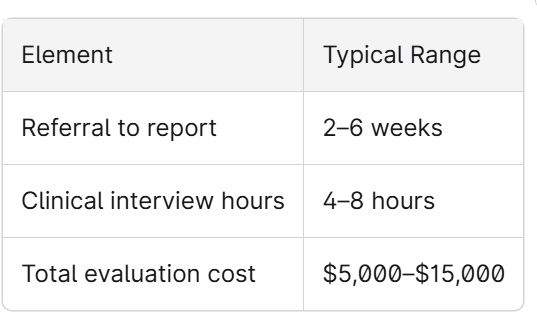
Timeline and Fees
Rush services may be available depending on case complexity and scheduling.
Communication With Counsel
Throughout the process, we maintain clear communication:
Draft findings shared before finalization
Pre-sentencing conference to discuss themes and strategy
Assistance developing mitigation narratives
Preparation for direct and cross-examination
Expert Testimony and Court Experience
Forensic experts at Lighthouse Resolution Group have extensive experience providing expert testimony in state and federal courts at both trial and sentencing phases.
What to Expect From Expert Testimony
Effective expert testimony requires:
Clear, jargon-free explanations that judges and juries can understand
Careful attention to legal standards for admissibility and reliability
Composed, respectful responses under cross-examination
Acknowledgment of limitations without undermining core opinions
Our experts prioritize neutrality and ethics over advocacy. This approach improves credibility before judges and juries—and produces testimony that withstands scrutiny.
Types of Hearings
Expert witnesses from our practice regularly testify at:
Sentencing hearings (state and federal)
Mitigation phases in capital cases
Post-conviction relief hearings
Stand trial competency hearings
Transfer or waiver hearings for young offenders
Credentials and References
Attorneys evaluating experts for their case can request:
Current curriculum vitae
Sample redacted reports (where appropriate and with proper authorization)
References from prior retaining attorneys
We understand that attorneys need to assess fit before retaining an expert. We’re happy to discuss qualifications, methodology, and approach during initial consultation.
Geographic Service Area (National / Remote Options)
Lighthouse Resolution Group provides forensic psychological services both in-person and through secure remote options, extending our reach to attorneys and clients nationwide.
In-Person Services
We are based in Melbourne, FL and provide in-person evaluations throughout our primary service region. We also have travel agreements throughout the country as needed. In-person assessment is often preferred for:
Complex neuropsychological testing
High-stakes capital cases
Cases where behavioral observation is particularly important
Defendants in local detention facilities
Remote and Telehealth Options
For cases outside our immediate region, we offer secure telehealth evaluations when permitted by licensing regulations and court rules. Remote services include:
Clinical interviews via HIPAA-compliant video platforms
Adapted psychological testing
Attorney consultation and case screening
Expert testimony via video when courts allow
Remote options can reduce costs by 20–30% through eliminated travel expenses while maintaining evaluation quality.
Limitations and Considerations
Some situations require in-person evaluation:
Specialized neuropsychological testing
Cases where in-person observation is clinically necessary
Court orders requiring physical presence
We coordinate with legal teams across multiple jurisdictions, including arranging access to detention facilities, working with local counsel, and navigating jurisdiction-specific requirements.
Contact us to discuss jurisdiction-specific questions and scheduling for mitigation or other forensic evaluations.
Additional Forensic Psychological Evaluation Services
Beyond criminal mitigation evaluations, Lighthouse Resolution Group offers a range of forensic assessment services tailored to specific legal questions.
Criminal Evaluations
Competency to stand trial: Assessing whether defendants can understand proceedings and assist counsel
Criminal responsibility (insanity defense): Evaluating mental state at the time of the alleged offense
Risk and violence assessment: Evidence-based predictions of future dangerousness
Sex offender evaluations: Risk assessment and treatment recommendations
Civil Evaluations
Personal injury: Psychological damages in civil cases and civil matters
Fitness for duty: Workplace psychological functioning assessments
Sexual harassment claims: Psychological impact evaluation
Immigration Evaluations: Asylum, Extreme Hardship Waivers, VAWA Petitions, U-Visas, Cancellation of Removal
Family Court Evaluations
Custody evaluations: When psychological factors are relevant to parenting capacity
Parental fitness assessments: Evaluating mental health and functioning
Each service follows established ethical and professional guidelines, with methodology tailored to the psycho-legal question posed. All forensic services are separate from therapeutic treatment—our role is to evaluate and inform, not to treat.
Clinical psychologists and forensic experts serve different functions in legal matters. While medical doctors (including forensic psychiatrists with doctorate degrees) focus on psychiatric diagnosis and medication, licensed psychologist experts like those at our practice offer detailed assessments of psychological functioning, personality, and cognitive abilities through extensive testing and clinical expertise.
How to Refer a Case or Schedule an Evaluation
Referring a case to Lighthouse Resolution Group is straightforward. Attorneys, courts, and agencies can initiate contact through:
Phone: 321.419.4947
Secure email: LHRgroup@lighthouseresolution.com
Contact form: Contact | Lighthouse Resolution Group
Information Needed for Intake
To streamline the consultation process, please have the following available:
Jurisdiction and court
Current charges
Upcoming deadlines or court dates
Key legal questions the evaluation should address
Relevant history (prior assessments, treatment records, known diagnoses)
Current custody status of the defendant
Initial Consultation
A brief initial consultation allows us to:
Determine scope and fit
Estimate timeline and costs
Ensure the evaluation question is appropriate and answerable
Screen for conflicts of interest
Important Note
Lighthouse Resolution Group provides forensic consultation and evaluation services. We do not provide legal advice. Individuals involved in legal proceedings should consult their own attorney for guidance on legal matters.
Our practice is committed to clear, ethical, and scientifically grounded forensic psychological evaluations that assist courts in making informed, fair decisions. Whether you need a mitigation evaluation, competency assessment, or expert psychological evaluations for civil cases, we bring psychological knowledge and forensic expertise to every individual case.
Ready to discuss a case? Contact Lighthouse Resolution Group today to schedule an initial consultation and learn how forensic evaluation services can support your client’s case.